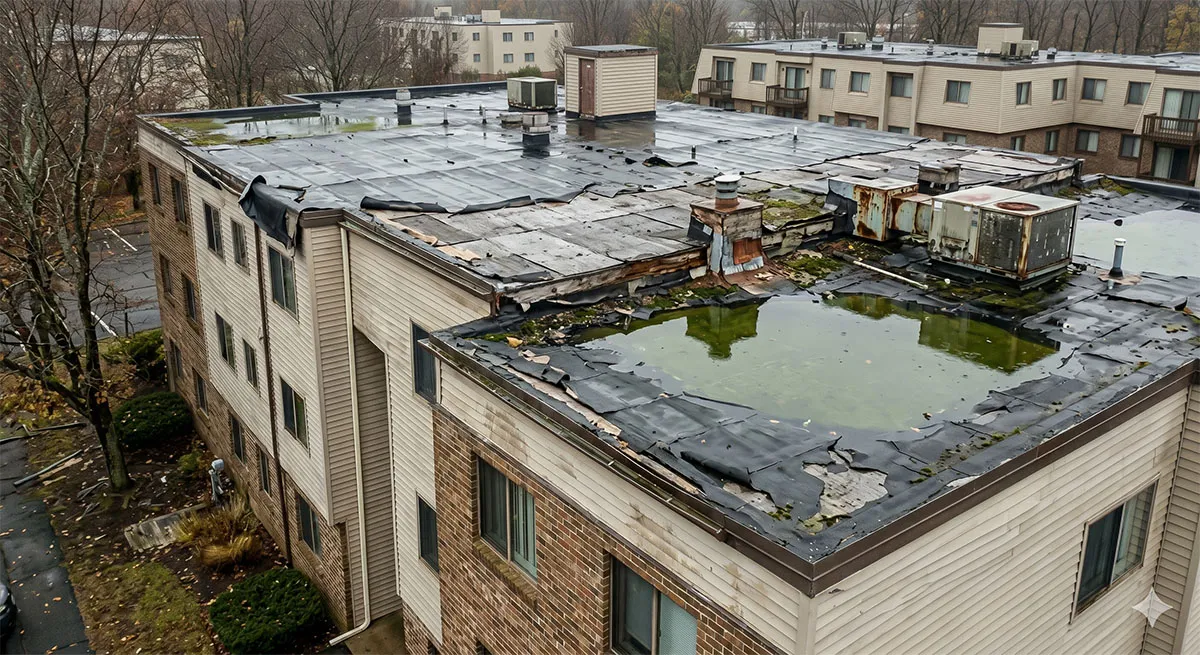
An HOA reserve study is one of the most important financial planning tools a community association has — yet many boards either don’t have one or treat it as a static document that collects dust between updates. The result is predictable: underfunded reserves, surprise special assessments, and a board of directors making capital decisions based on guesswork rather than data.
For Connecticut condominium associations in particular, where most building stock dates to the mid-1980s and early 1990s, the question isn’t whether major systems will need repair or replacement. They will. The question is whether your community will be financially prepared when that day comes. A well-executed reserve study answers that question with specifics, not assumptions.
What is an HOA reserve study?
An HOA reserve study is a professional assessment that combines a physical analysis of a community’s common-area components with a financial analysis of its reserve fund. The purpose is to determine what the association is responsible for maintaining or replacing, when those projects will likely be needed, what they’ll cost, and whether the current reserve fund balance and contribution rate are sufficient to cover them.
A full reserve study typically includes a component inventory (every major element the association must maintain), a condition assessment based on a site visit, estimated useful life and replacement costs for each component, an evaluation of the current reserve fund balance, and a funding plan that projects income and expenses over a minimum of 20 years. The end product gives the board of directors a clear picture of the community’s financial health and a roadmap for long-term capital planning.
Think of a reserve study the way you’d think about a home inspection before buying a house. You wouldn’t commit to a major purchase without understanding the physical condition of the asset and what it will cost to maintain. An association’s common areas deserve the same scrutiny, because every unit owner’s investment depends on it.
What a reserve study includes
The scope of a reserve study varies depending on the type of study and the community’s needs, but a comprehensive study includes both a physical analysis and a financial analysis.
Physical analysis
The physical analysis begins with a site inspection conducted by a reserve specialist or other qualified professional, such as an engineer or architect. During the site visit, the specialist inventories all common-area components the association is responsible for, assesses the physical condition of each one, and estimates remaining useful life based on current condition, maintenance history, and industry standards.
For a typical Connecticut condominium, common-area components might include roofing systems, siding and exterior trim, windows and sliding doors (if the association’s governing documents assign responsibility to the association), paving and parking areas, concrete sidewalks and curbing, retaining walls, fencing, landscaping and irrigation, pool and clubhouse facilities, elevators, fire suppression systems, HVAC systems for common areas, and drainage infrastructure. The specific list varies by community. What matters is that nothing material gets left out.
Financial analysis
The financial analysis takes the physical findings and translates them into numbers. It examines the current reserve fund balance, the current annual reserve contributions, projected replacement costs for each component (adjusted for inflation), anticipated interest earnings on reserve funds, and the timing of each projected expense over the study’s planning horizon.
The output is a funding plan that shows the board whether current contribution levels will keep the reserve fund balance adequate over time, or whether adjustments are needed. A well-constructed funding plan accounts for the real cost trajectory of construction and materials in your market — not generic national averages.
Reserve study levels: how they differ
The Community Associations Institute (CAI) defines four levels of reserve studies, each suited to a different stage in a community’s planning cycle.
A Level I (Full Reserve Study) is the most comprehensive option. It includes a complete site inspection, a full component inventory with measurements and condition assessments, and a detailed financial analysis with a multi-decade funding plan. This is what communities should start with if they’ve never had a study done, or if it’s been more than five years since the last full study with a site visit.
A Level II (Update with Site Visit) revisits the prior study’s findings through a new on-site inspection. The reserve specialist confirms that component quantities and conditions match the previous assessment, updates useful life and cost estimates where needed, and produces a revised funding plan based on the current reserve fund balance.
A Level III (Update without Site Visit) is a financial-only update. It adjusts the prior study’s projections using current cost data, actual reserve fund contributions, and expenses since the last report, but does not include an on-site inspection. This can serve as an interim check between full updates, but it should not replace periodic site visits.
A Level IV (Preliminary Study) is designed for communities that haven’t been built yet. Developers use these to establish initial reserve budgets based on design plans and industry standards rather than observed conditions.
Industry best practice, as recommended by CAI, calls for a full reserve study with a site visit every three to five years, with lighter updates in the interim. Annual review of the study during budget season keeps the numbers current without requiring a full engagement every year.
How much does an HOA reserve study cost?
Cost is usually the first question a board asks, so here are realistic ranges for Connecticut communities. They are typical market figures, not a quote — the right number for your association depends on what the specialist has to inventory.
A Level I full reserve study with a site visit typically runs $2,500 to $6,000 for a small-to-mid-size condominium or HOA — roughly 20 to 150 units with standard components like roofing, siding, paving, and a clubhouse. Larger communities, and communities with elevators, pools, fire suppression, multiple buildings, or waterfront infrastructure, commonly fall in the $8,000 to $15,000+ range, because the component inventory and engineering time scale with complexity.
A Level II update with site visit generally costs 50 to 70 percent of a full study, since the specialist is confirming and adjusting an existing inventory rather than building one. A Level III financial-only update usually lands between $800 and $2,000.
What moves the price:
- Number and complexity of components. A 40-unit townhome HOA with roofs and paving is a short inventory. A 120-unit mid-rise with two elevators and a central boiler plant is not.
- Buildings and acreage. More to walk, measure, and photograph.
- Quality of existing records. Communities with organized maintenance histories, prior studies, and as-built drawings are cheaper to study, because the specialist isn’t reconstructing history on site.
- Credentials and travel. RS- and PRA-credentialed firms cost more than a contractor’s rough estimate, and are worth it. Lenders, auditors, and counsel treat the credentialed study as the defensible one.
Put the number in context. A community holding $600,000 in reserves that commissions a $4,500 study every four years is spending under 0.2 percent of the fund per year to know whether the fund is adequate. One mistimed roof project or one avoidable special assessment costs more than a decade of studies. Boards that skip the study to save money are usually about to spend far more than they saved.
What a reserve study report looks like — a working template for boards
Boards searching for a reserve study template are usually looking for one of two things: what a finished study should contain, or a simple format for keeping it current. Here is both.
A professional reserve study report follows a consistent structure regardless of the firm that prepares it: an executive summary with the current percent funded and the recommended annual contribution; the component inventory (the schedule below); the funding plan, usually a 20- or 30-year projection of contributions, expenses, interest, and year-end balances; and the assumptions behind it — inflation rate, interest rate, and the funding goal, whether full funding, threshold funding, or baseline funding.
Sample component schedule
The component schedule is the heart of the study. Every row is an asset the association is responsible for, and every column feeds the funding plan. A simplified version for a hypothetical 1980s Connecticut mid-rise:
| Component | Quantity | Useful life | Remaining life | Current replacement cost |
|---|---|---|---|---|
| Asphalt shingle roof | 18,400 sq ft | 25 yrs | 6 yrs | $210,000 |
| Asphalt paving, mill and overlay | 32,000 sq ft | 20 yrs | 3 yrs | $96,000 |
| Elevator modernization (2 cabs) | 2 | 25 yrs | 9 yrs | $260,000 |
| Boiler plant | 2 units | 25 yrs | 11 yrs | $145,000 |
| Exterior sealant and painting | 1 cycle | 7 yrs | 2 yrs | $58,000 |
| Fire alarm panel | 1 | 15 yrs | 4 yrs | $34,000 |
The figures are illustrative, not a quote for any community. The point is the structure: quantity, useful life, remaining life, and current cost are what the reserve specialist measures on site, and a board can read the table and immediately see the next three to five years of capital exposure.
The monthly reserve tracking sheet
Between full updates, the study should be kept live with a one-page tracking sheet. CPE publishes one to every board monthly through our Smart Properties partnership, and the fields are simple enough that any accounting team can produce them:
- Reserve balance at month end, against the balance the study projected for that month
- Year-to-date contributions, against the study’s recommended annual contribution
- Interest earned year to date
- Capital expenses paid year to date, tagged to the component they replaced
- Current percent funded, recalculated
- Components due within 24 months, with the study’s cost estimate beside any bids in hand
If your manager or accountant can’t produce those six lines each month, the study is a shelf document. Here is how live reserve tracking works inside CPE’s accounting service, and how it fits into full-service HOA management.
Is a reserve study required by law in Connecticut?
Connecticut does not require associations to commission a formal reserve study. However, state law does require that association budgets provide for adequate reserves for capital expenditures. Under CIOA (Section 47-261e), when the board presents its proposed budget to unit owners, it must include a statement of the amount of any reserves and the basis on which those reserves are calculated and funded.
That “basis” requirement is the key. If your board is asked to demonstrate that its reserves are adequate, a professional reserve study is the most defensible way to answer that question. A number pulled from a general estimate or carried forward from a prior year’s budget without analysis won’t hold up to scrutiny from unit owners, auditors, lenders, or legal counsel.
It’s also worth noting that lender guidelines can be stricter than state law. Fannie Mae and FHA both evaluate a condominium association’s financial health when determining whether units in that community qualify for conventional financing. A community with no reserve study and visibly underfunded reserves may see its units become harder to sell, because buyers can’t get approved for standard mortgage products. Protecting property values means protecting your community’s financial profile — and a current reserve study is central to that. For a practitioner walkthrough of how the new 15% Fannie/Freddie reserve requirement changes this calculus, watch our on-demand webinar on the new reserve rules.
How a reserve study supports long-term financial planning
A reserve study does more than tell you how much money is in the account today. It connects the physical condition of your community’s assets to a long-term financial plan, giving the board the data it needs to set contribution levels that are sustainable rather than reactive.
Without a reserve study, boards tend to fall into one of two patterns. Some keep reserve contributions artificially low to avoid raising common charges, deferring the financial reckoning to a future board. Others react to individual problems as they arise, funding major projects through special assessments or loans that shock homeowners and erode trust. Neither approach is governance. Both are avoidable.
When reserve studies become living tools — reviewed annually during budget preparation, updated with actual contributions and expenses, and connected to real maintenance schedules — they transform from a static report into the backbone of the community’s financial plan. Boards can see exactly where they stand, what’s coming in the next 5, 10, and 20 years, and whether they’re on track or falling behind. That kind of clarity makes board service feel like focused governance rather than crisis management.
A reserve study shouldn’t collect dust on a shelf.
The real value of a reserve study comes from connecting it to your annual budget, your capital planning, and the decisions your board makes every quarter. If your community is ready to turn reserve data into a financial plan you can actually govern from, schedule a conversation with CPE.
Frequently asked
What is included in a reserve study for an HOA?
A reserve study includes two core components: a physical analysis and a financial analysis. The physical analysis involves a site inspection where a reserve specialist inventories all common-area components the association is responsible for, assesses their current condition, and estimates remaining useful life and replacement costs. The financial analysis evaluates the current reserve fund balance and contribution rate against projected future expenses, then produces a funding plan spanning at least 20 years. The specific components covered vary by community but typically include roofing, paving, siding, elevators, pools, mechanical systems, and other shared infrastructure.
Is a reserve study required by law?
Requirements vary by state. In Connecticut, there is no statutory mandate to commission a professional reserve study. However, CIOA does require that association budgets include adequate reserves for capital expenditures and that the board disclose reserve amounts and the basis for how they are calculated. A professional reserve study is the standard tool for meeting that obligation defensibly. Lender guidelines from Fannie Mae and FHA also evaluate a community's reserve health when approving mortgages, which means an inadequate reserve profile can affect unit marketability regardless of state law.
How does a reserve study affect HOA dues?
A reserve study directly informs the reserve contribution portion of your community's annual budget, which is one of the primary components of common charges. If the study reveals that current contributions are insufficient to cover projected capital expenses, the board may need to increase the reserve contribution, which in turn affects dues. The alternative — underfunding reserves and relying on special assessments or loans when major expenses arise — is almost always more expensive and more disruptive. A properly funded reserve plan spreads costs predictably over time so homeowners aren't hit with sudden, large assessments.
How large should HOA reserves be?
There is no single dollar figure or percentage that applies to every community. The appropriate reserve fund balance depends on the age, size, and physical condition of the community's common-area components, the projected timing and cost of future repair or replacement projects, and the current funding plan. Industry guidance generally considers a community to be in good financial health when its reserve fund is at least 70% funded relative to the projected needs identified in its reserve study. Connecticut law does not set a fixed percentage but requires adequate reserves. The only reliable way to determine what 'adequate' means for your specific association is through a professional reserve study tailored to your community's assets and conditions.
How much does an HOA reserve study cost?
For most Connecticut condominium and HOA communities, a full Level I reserve study with a site visit typically runs $2,500 to $6,000. Larger or more complex properties — elevators, pools, fire suppression, multiple buildings, waterfront infrastructure — commonly reach $8,000 to $15,000 or more because the component inventory and engineering time scale with complexity. A Level II update with a site visit generally costs 50 to 70 percent of a full study, and a Level III financial-only update usually falls between $800 and $2,000. Spread across the recommended three-to-five-year cycle, the study works out to a fraction of one percent of the reserve fund it protects.
Is there a template for an HOA reserve study?
Boards should not build a reserve study from a template. The study itself should come from an independent, credentialed reserve specialist (RS or PRA), because lenders, auditors, and counsel treat the credentialed study as the defensible one. What a board should standardize is the format for keeping the study current between updates: a component schedule listing each asset with its useful life, remaining life, and current replacement cost, plus a one-page monthly funding snapshot that compares the actual reserve balance and contributions against the study's plan. The sample component schedule and tracking fields in this guide show that structure.